Why Small Conservation Steps Matter
Finding the Balance Between Strip‑Till and No‑Till
When you are looking for ways to manage farmland more efficiently and profitably, the most sustainable changes often happen one small step at a time. Each new conservation practice can create a positive domino effect, improving soil health, protecting water quality, and supporting long‑term yields through both strip‑till and no‑till systems. This approach is exactly what Brent Larson with Sunderman Farm Management has seen on his family’s north‑central Iowa operation, where strip‑till, no‑till, and cover crops now work together as part of a conservation‑focused farm management strategy. In addition to sustaining the land, these methods have increased net revenue.
Brent farms with his brothers, Karl and Eric, and their father, Brian, in Webster and Humboldt counties. The family’s conservation journey began in the early 2000s, but their mindset was shaped much earlier. Brian worked with the Soil Conservation Service in the 1960s and saw firsthand how grassed waterways and terraces could dramatically reduce erosion and protect soil. “Some of our fields are rolling and hilly, especially near creeks and rivers,” says Brent.
Conservation practices became the foundation for managing surface water runoff and keeping soil in place. By slowing runoff and guiding water safely off the field, terraces and waterways help reduce sediment and nutrient loss while allowing more water to infiltrate into the soil. Many of these structural conservation practices are still in place today and continue to support the family’s strip‑till and no‑till decisions.
Rethinking Tillage on a Working Farm
The next major shift came when the Larsons began rethinking how much tillage they actually needed. Brent credits Michigan corn and soybean farmer Ray Rawson for influencing their thinking in the early 2000s. Rawson’s example showed that it was possible to reduce tillage, lower workload, and still maintain a strong return on investment. That message resonated on a farm where family members also held jobs in town and needed to make the most of their time and equipment. “If we could reduce fuel and equipment costs and save time with reduced tillage, with no drop in net income, we figured, ‘Why not?’” Brent says.
As they cut back on passes and moved toward reduced tillage, they saw real economic benefits, including savings in fuel and machinery costs, without sacrificing net income. Brent added, “We found that we gained about $50 per acre.”
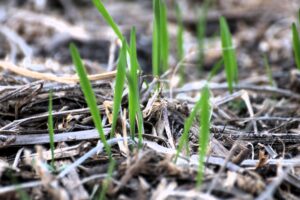
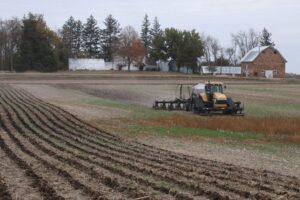
From there, the family began exploring strip‑till as a way to balance soil conservation with corn’s agronomic needs. Strip‑till disturbs only a narrow band of soil where the seed and often fertilizer are placed, leaving residue undisturbed between the rows. For farmers interested in strip‑till vs. no‑till, this system can provide the best of both worlds: the warmer, drier seedbed associated with conventional tillage and the residue cover and erosion control associated with no‑till. The Larsons tried multiple strip‑till machines and fine‑tuned their management before dialing in a system that fit their soils and yield goals. At the same time, they began integrating more true no‑till, especially in soybeans. As a fourth‑generation farmer, Brent notes that no‑tilling soybeans with a drill works very well on their operation, while corn typically performs best in a warm, black strip created by strip‑till on their heavy black soils.
Adding Cover Crops to Support Strip‑Till and No‑Till
Around 2010, the Larsons took another step in their conservation journey by seeding cover crops across their acres. For farmers evaluating strip‑till and no‑till methods, cover crops are a natural complement because they keep living roots in the soil longer, which supports soil structure, biology, and nutrient cycling. Brent explains that maintaining a living root in the soil as much of the year as possible adds biodiversity, builds soil health, sequesters nutrients, and helps control erosion. On their operation, cover crops fit directly into their reduced‑tillage, no‑till, and strip‑till systems, protecting the soil surface, improving water infiltration, and helping stabilize yields over time.
Importantly, they do not reserve these conservation practices only for their highest‑rated fields. The family manages a field with a corn suitability rating (CSR2) of 51, on a scale of 5 to 100, where higher numbers indicate more productive soils, using the same strip‑till and cover crop system as on more productive ground. In that field, they harvested 215 bushels of corn per acre. For Brent, that yield on a CSR2 51 field is clear evidence that conservation practices like strip‑till, no‑till, and cover crops can perform well even on more variable soils. It reinforces a key message for farmers comparing strip‑till versus no‑till: conservation does not have to come at the expense of yield when systems are managed carefully.
Turning On‑Farm Experience Into Practical Advice
The Larsons’ experience also shapes how Sunderman Farm Management advises clients who are interested in conservation tillage, strip‑till, no‑till, and cover crops. “We like to try new farming techniques on our own family farm before we implement them on our professionally managed farms,” Brent said.
That on‑farm testing helps identify which strip‑till setups, no‑till practices, cover crops, and nutrient strategies actually work under real‑world conditions. It also helps them understand how these practices behave on different soil types, slopes, and yield levels, and how they can be integrated into existing machinery and labor schedules.
Because there is no one‑size‑fits‑all approach to conservation, Sunderman Farm Management tailors management practices to each field and operation. Some farms may start with structural practices, such as terraces and grassed waterways, to address visible erosion. Others may transition from full‑width tillage to strip‑till in corn, adopting no‑till soybeans, or adding a cereal rye cover crop ahead of corn and soybeans. For many, it will be a combination of steps taken over several years rather than a single, dramatic change. The key is to move at a pace that fits the operation, while still making progress toward healthier soils, better water management, and more resilient yields.
Taking the Next Step on Your Farm
If you are a farmer exploring strip‑till and no‑till methods and you want to add more conservation to your acres one step at a time, Sunderman Farm Management can help you evaluate options and design a system that matches your fields, equipment, and goals. Their experience with reduced tillage, strip‑till, no‑till, and cover crops on their own farm gives them practical insight into what works and how to implement changes without disrupting the core of your operation. Reaching out for a conversation can be the first small step in a series of changes that improve soil health, protect water quality, and support your bottom line well into the future.